

Crested Caracara (Caracara plancus); Caracara cargahuesos; Schopfkarakara; Caracara huppé
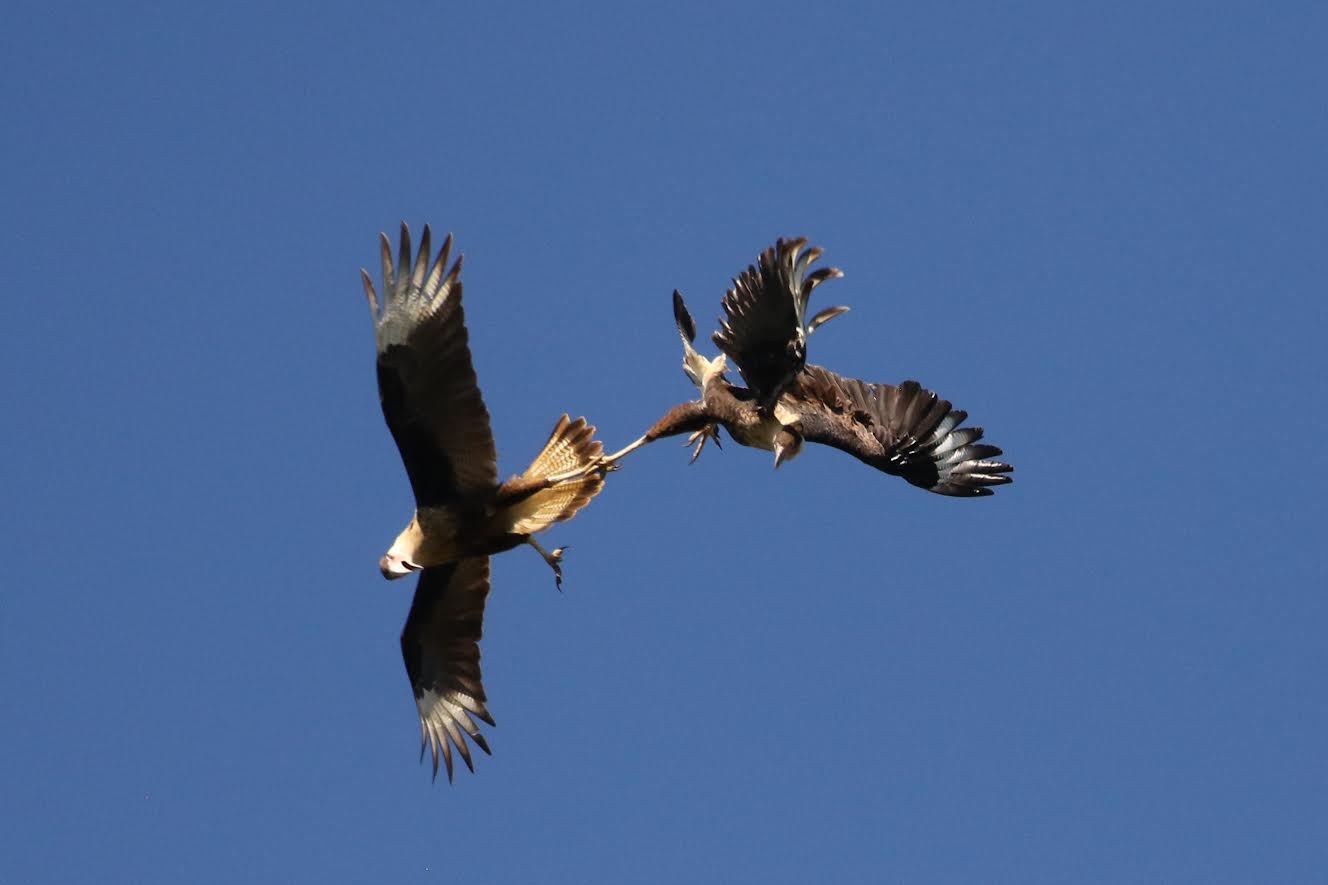
At 23″ with wings outspread, the Crested Caracara is a large bird, almost as big as the ubiquitous Black Vultures with which it often soars. It feeds mostly on carrion but also hunts small animals It ranges widely from the southernmost parts of Texas, Arizona and Florida to the southernmost tip of South America. One hot summer I had the extraordinary good luck to find it as far north as the vicinity of Dallas, not too far from the Oklahoma border. The following series of unusual photos were taken this year on February 23 at Angostura by John Beer. The shots of the ‘dueling’ pair have been judged to be likely examples of a rarely photographed courtship display.
Costa Rica is home to 3 different species of Caracara but this is the largest and the most widespread. Unlike our other 2 species – the Yellow-headed Caracara (Daptrius chimachima) and the Red-throated Caracara (Ibycter americanus) – the Crested Caracara (Caracara plancus) is now being increasingly reported, even above 1500 meters. Moreover, it is now no longer uncommon in the Turrialba area. Here’s a close-up of one of the pair that John found at Angostura at an elevation of some 640 m. The salient field marks of what seem to be second-year birds are clearly visible – the head is mostly white while the belly is very dark. The colours of the pale orange-red facial skin and cere will become more pronounced in a fully adult bird, as will the blue of the heavy bill:

What follows is a remarkable sequence of Crested Caracara images shot on a day of clear-blue skies. The pair is captured as if tussling in courtship:


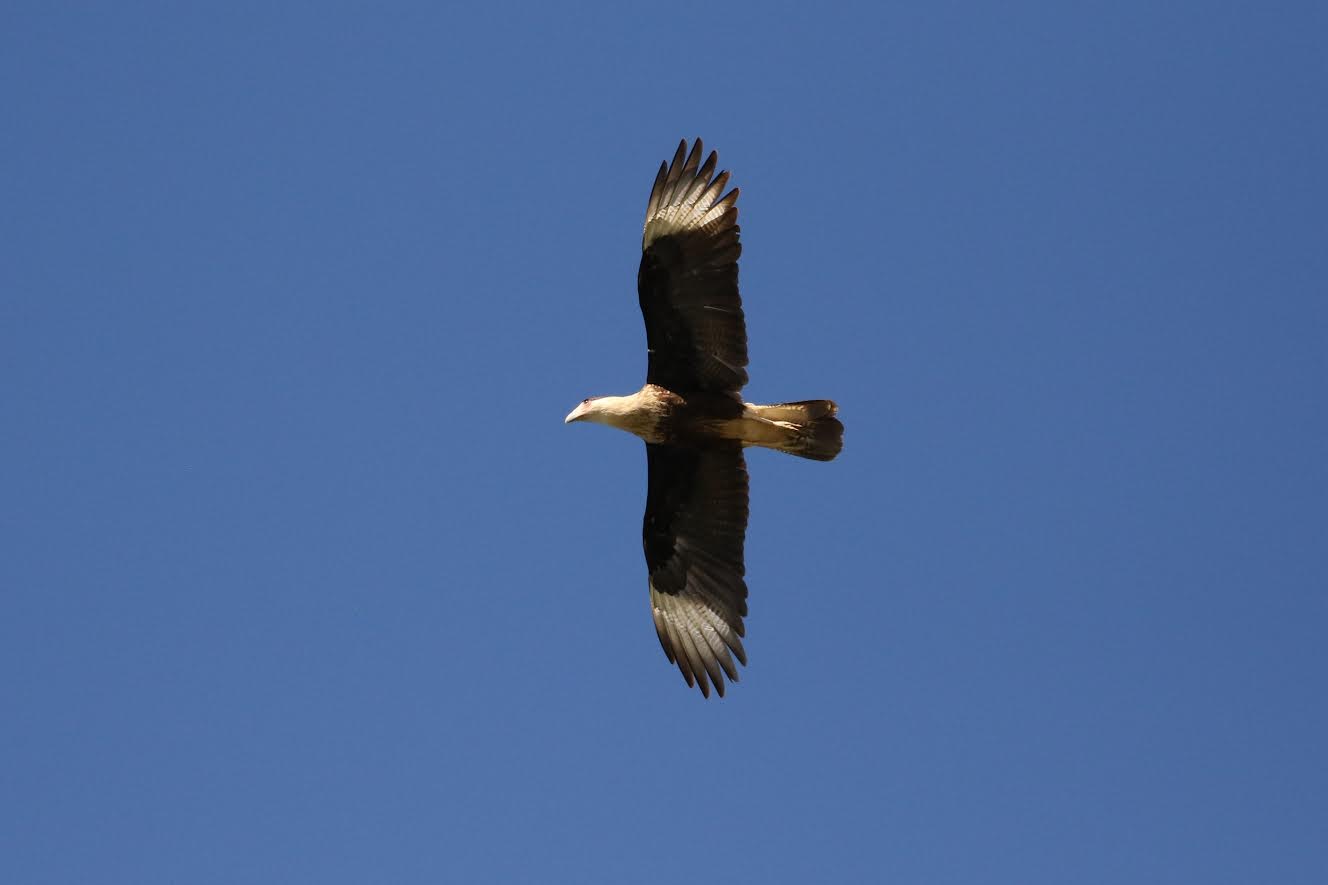
Caracaras were initially classed as relatives of the hawk family but are now grouped with the Falconidae. Here’s a final photograph of one of the Crested Caracara pair:
You may have noticed the most recent changes to the scientific names of both the Crested and the Yellow-headed Caracara (Daptrius chimachima). This latter species is rapidly increasing its range within Costa Rica. At first it was restricted chiefly to the Pacific, but visiting birders should now expect to encounter it in our area without too much difficulty. It can be found from northern Guatemala and Belize southwards into northern and central South America. The Yellow-headed Caracara is a much smaller bird than the Crested Caracara but in flight at a distance the two species are not always easy to distinguish between. However, a good close look should dispel any doubt:
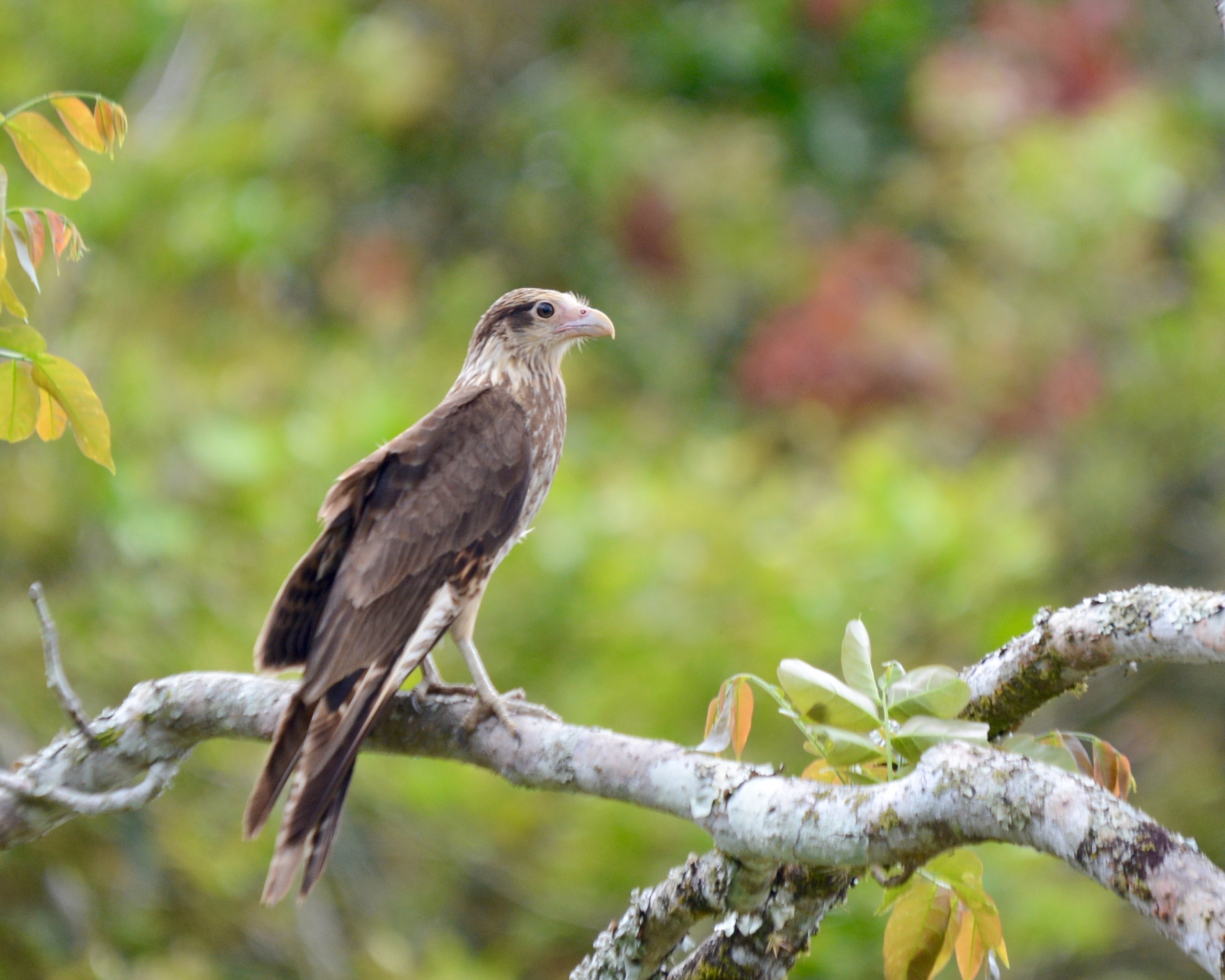
Be aware that this Caracara species has often been seen scavenging in the streets of Turrialba in the early morning together with the much bigger Black Vultures. Here’s a file photo of an immature Yellow-headed Caracara dating from March 2017, courtesy of friend Larry Waddell. First-time visitors to Costa Rica will be forgiven for thinking that they are looking at a small hawk or falcon:
To conclude this Caracara post I can’t resist repeating Larry’s photo of an adult Yellow-headed Caracara that featured in an earlier post a few years ago:

And last but not least, an adult Crested Caracara, courtesy of an unknown contributor many years ago:

Your are unlikely to encounter our remaining Costa Rican caracara species, the Red-throated Caracara (Ibycter americanus) for which only a few very scattered reports exist in Costa Rica – none in our area. But then again, this is Costa Rica and you never know!
 Birds for Beer